
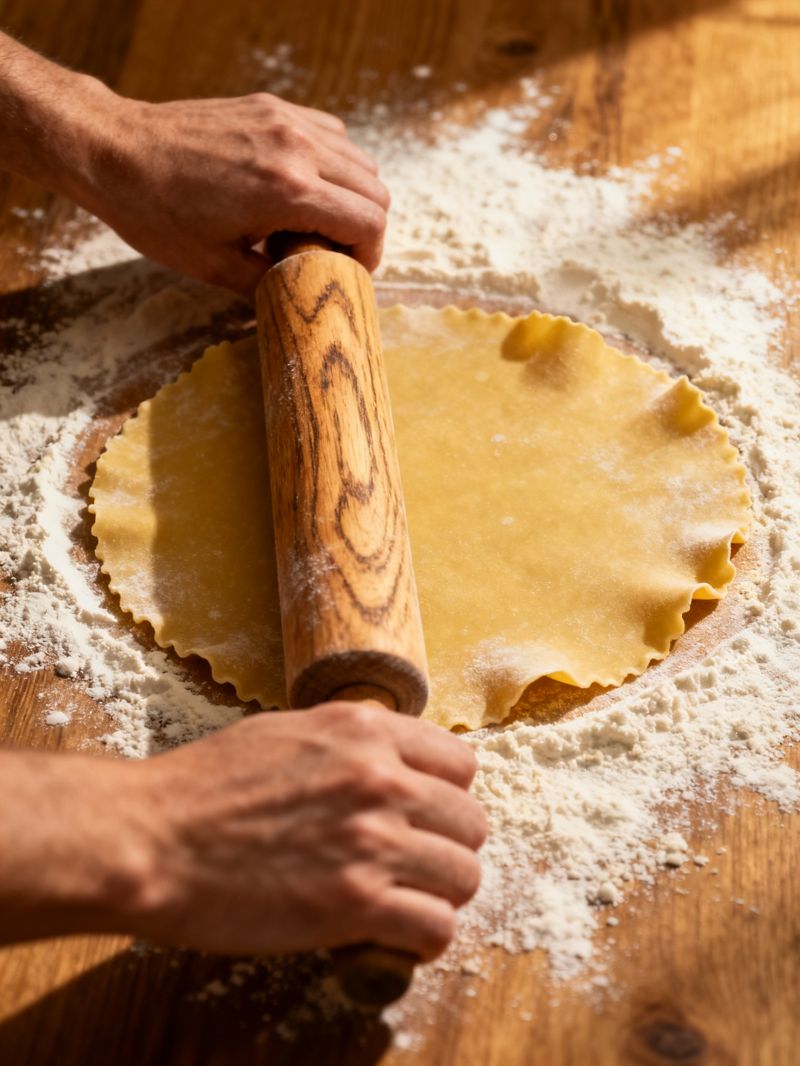
You haven't really made lasagna until you've made sagna. That's not a typo—it's what my grandmother from Emilia-Romagna called the fresh egg pasta sheets she rolled by hand, the ones that make you realize the boxed stuff is a distant cousin at best. Sagna is the foundation of a proper baked pasta, and getting it right changes everything about the final dish. I learned this the hard way, after a decade of soggy。over-sauced attempts that looked great in photos and tasted like wet cardboard. The turning point was a Sunday afternoon in a cramped Bologna kitchen, watching my aunt slap a sheet of sagna against the counter to check its elasticity. She didn't measure anything—just flour, eggs, and a feel for the dough that took her thirty years to develop. I'm not suggesting you spend three decades on it, but a few practical tweaks will get you ninety percent of the way there.Start with the dough: 400 grams of tipo 00 flour and four large eggs, nothing else. That's the classic ratio, and it works. Mix it on a board, knead for a full ten minutes until the surface is smooth and slightly tacky, then wrap it and let it rest for thirty minutes. The rest is non-negotiable—skip it and the gluten fights back when you roll. You'll want to roll it thin, about 2 millimeters, which is roughly the thickness of a penny. A pasta machine helps, but a long wooden rolling pin gives you more control. Dust generously with semolina, not flour。to prevent sticking;
semolina's coarser texture creates tiny air pockets that help sauce cling later. I keep a small bowl of it nearby and sprinkle it like I'm salting a steak. Too much flour makes the sagna tough, and semolina sidesteps that problem.Blanching the sagna sheets for thirty seconds in salted water before layering is a step many recipes skip. Don't skip it. Fresh pasta releases starch that can gum up the layers。and a quick dip removes the excess. Have a bowl of ice water ready to shock the sheets, then lay them flat on clean kitchen towels. This is also where you can make a batch ahead—blanched sagna sheets keep in the fridge for two days, stacked with parchment between them. I usually make a double batch on Sundays and freeze half;they thaw in minutes and taste almost as good as fresh. The texture holds up remarkably well, especially if you're using a hearty ragù.Layering is where most people go wrong, and I include myself in that group for years. The rule I follow now: sauce, sagna, béchamel, cheese, repeat。but keep each layer thin. A heavy hand with sauce turns the whole thing into soup. My standard ratio is 200 grams of ragù per layer for a 20x30 cm dish, spread almost transparently thin with the back of a spoon. Béchamel should be just as thin—about 150 grams per layer—and grated Parmigiano-Reggiano goes on last, never mixed into the béchamel. That's a northern Italian habit I picked up from a friend in Modena, and it creates a nutty crust that contrasts with the soft interior. Bake at 180°C for forty minutes, then rest for fifteen before cutting. The rest is crucial;cutting too early means the layers slide apart, and you'll end up with a delicious mess instead of clean squares.
One more thing about sagna: it's forgiving in ways other pasta isn't. If your sheets tear, patch them—overlapping edges disappear under sauce and cheese. If you're short on ragù, stretch it with sautéed mushrooms or a handful of peas. I've made sagna with leftover roast chicken and a lemon-ricotta filling。and it worked beautifully. The point is to treat sagna as a canvas, not a rigid formula. The best version I ever had was in a farmhouse outside Parma, where the cook used a three-day-old ragù and a béchamel so light it was almost a crepe batter. She shrugged when I asked for the recipe. 'You just know,' she said. After enough batches, you will too.